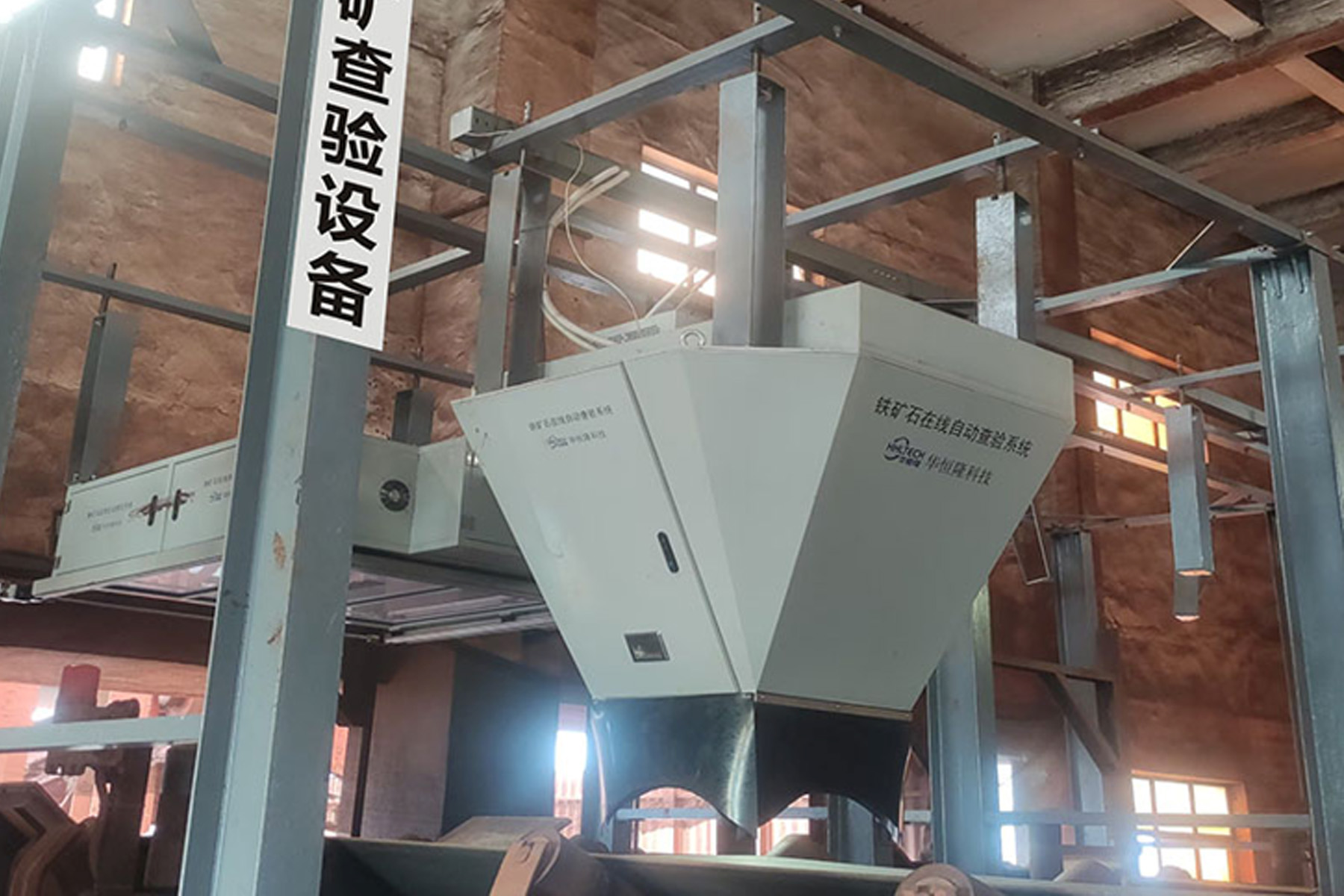
AI-Powered Quality Control for Iron Ore Terminals
Huahui's Intelligent Iron Ore Inspection System uses near-infrared spectroscopy, deep learning computer vision, and high-sensitivity gamma-ray detection to continuously analyse iron ore composition, detect foreign objects, and monitor radioactivity — all non-destructively on live conveyor belts without stopping operations.
A near-infrared spectrometer (900–2,300 nm) analyses spectral fingerprints of ore on the moving belt in real time — identifying iron ore type (Magnetite, Hematite, Limonite, Goethite) and flagging solid waste, without sampling or stopping the conveyor.
Two 12-megapixel industrial cameras (0.35 mm/pixel, 1.8×1.8m field accuracy) feed a deep learning pipeline using ResNet50 and anomaly detection models — identifying known and previously unseen foreign objects at belt speed.
A 25-litre high-sensitivity gamma-ray detector with dual scintillation crystal modules continuously screens for trace radioactive materials in ore shipments — with a proprietary background discrimination algorithm that compensates for environmental radiation fluctuation.
No sample preparation, no belt stoppage, no chemical treatment — the entire inspection system operates continuously alongside normal port operations, maintaining throughput while delivering inspection data.
Local edge processing delivers real-time detection and alerts, while a cloud platform aggregates inspection data, analytics dashboards, and trend reporting — integrating with raw material handling and furnace control systems.
Continuous conveyor performance monitoring data feeds into predictive maintenance workflows — identifying wear patterns and optimising service schedules to minimise unplanned downtime.
Port iron ore terminal incoming quality screening
Steel mill raw material acceptance inspection
Mining operation ore grade monitoring and routing
Bulk cargo radioactivity compliance screening at port
Conveyor belt foreign matter detection in ore processing
Huahui's Intelligent Iron Ore Inspection System addresses three simultaneous challenges in bulk ore handling: composition variability, foreign object contamination, and radioactive material risk — all in a single, non-disruptive system installed at the conveyor belt.
The system is deployed at port raw material terminals, integrated with existing conveyor infrastructure via a specialised installation structure spanning the belt.
The system uses a Cloud-Edge-End design:
End layer (on-belt hardware):
Edge layer (local processing):
Cloud layer:
| Parameter | Value |
|---|---|
| Technology | Near-Infrared Spectrometer |
| Spectral Range | 900–2,300 nm |
| Analysis Method | Spectral fingerprint matching |
| Operation | Non-destructive, no sample preparation |
| Output | Ore type, composition estimate, solid waste flag |
| Ore Types Identified | Magnetite, Hematite, Limonite, Goethite |
The NIR system collects spectral data, preprocesses and normalises it, then runs real-time classification against a reference database that can be expanded with new ore categories without reprogramming.
| Parameter | Value |
|---|---|
| Camera | 2× 12-megapixel industrial cameras |
| Resolution | 0.35 mm/pixel |
| Field Accuracy | 1.8 × 1.8 m pixel area |
| Deep Learning Model | ResNet50 for known objects |
| Anomaly Detection | Feature nearest-neighbour search for unknowns |
| Edge Detection | Size, water, stains, empty belt detection |
| Operation | Real-time during full belt speed |
The system handles both known foreign matter (classified by training data) and unknown foreign matter (identified through anomaly detection — any object whose spectral or visual signature deviates significantly from normal ore).
| Parameter | Value |
|---|---|
| Detector Type | High-sensitivity gamma-ray |
| Effective Volume | 25 litres |
| Modules | 2× large scintillation crystal detector modules |
| Photomultiplier | Photomultiplier tubes |
| Background Compensation | Proprietary radiation background discrimination algorithm |
| Detection Capability | Trace radioactive materials in bulk ore flow |
The 25-litre detector volume provides sufficient sensitivity to identify radioactive hotspots in individual ore pieces within a continuous belt flow — an important compliance capability for ports handling ore from geologically diverse sources.
The system integrates with:
Get in touch with our team for a product demo, pricing information, or to discuss how Intelligent Iron Ore Inspection System can be deployed in your organisation.